Attribution Is a Trail, Not a Verdict
Follow an attributed claim back to its stated source, separate evidence from interpretation, and see what a news report has—and has not—established.

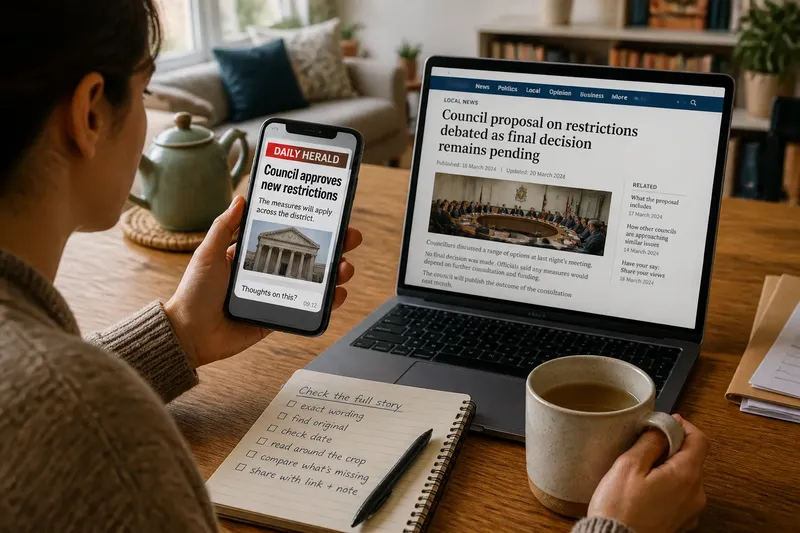
You are reading a report on your phone when a sentence catches your eye: “The council’s decision will leave families without support.” Who says so? The article attributes the warning to a local charity, but the sentence itself bundles a prediction with a claim about the council’s decision. Following attribution means tracing those parts back to their stated sources, then noticing where the trail stops. It is a way to read carefully, not a shortcut to a verdict.
Attribution is a trail, not a verdict: “according to” tells you where a claim is being placed, not whether every part of it is established. Keep three things apart as you read: what the report directly documents, what a source says that evidence means, and what remains unconfirmed or outside the report.
Start with the sentence carrying the claim
Find the exact wording that matters. A story may say a bridge is “unsafe”, that a policy “will raise bills”, or that an organisation “broke its promise”. Those phrases do different kinds of work. One may report a formal assessment, another a forecast, and another an accusation.
Mark the sentence mentally, then look for its attribution. “The inspection report describes cracks in the supports” points to a document and a specific observation. “Residents say the bridge feels unsafe” gives you residents’ experience, which may be important but is not the same as an engineering assessment. “The bridge is unsafe” might be the reporter’s wording, a source’s judgement, or a conclusion supported elsewhere in the article. The surrounding sentences should help you tell which.
Notice how much the wording claims. “A change took effect on Monday” is a claim about an event. “The change has harmed small shops” adds a claim about consequences. “Shop owners say the change has harmed them” reports their account, rather than independently establishing the full effect on shops.
Underline the verb, if you like: it often reveals whether a sentence describes, alleges, predicts or interprets.
Follow the attribution back one link
When a report names a source, ask what that source is in a position to know. A witness can describe what they saw or heard. A council document can establish what it records or formally decides. A campaign group can explain its own position and may offer information it has gathered. Each source has a different relationship to the claim.
Then look for the next link. Does the story name a document, quote a person, link to a public record or explain that information came through an organisation? If a report says “according to figures released by the department”, the stated source is the department’s figures. That does not automatically tell you how the figures were collected, what they include or whether the article has checked them against another record.
When a link is available, inspect the relevant passage rather than treating the link itself as confirmation. A report may cite a long document for one narrow point. Check whether the source actually says that, and whether the report has preserved a qualification such as “provisional”, “estimated” or “subject to review”. If the source is not publicly accessible, that is a limit on what you can check from the article alone; it is not, by itself, proof that the claim is false.
Say you read that a school timetable change will cut pupils’ access to the library, attributed to a parents’ group. The report also links to a timetable showing shorter opening hours. The timetable supports the change in hours; the parents’ group supplies the concern about its effect on pupils. To establish who can use the library, you would still need details such as supervised access or alternative arrangements. The two sources contribute different pieces.
Separate evidence from interpretation
Direct evidence is material that bears on the claim itself: a recorded decision, a published rule, a photograph of a visible condition, or a person’s account of what they witnessed. Interpretation explains what that material means. Reporting often needs both, but the reader should not mistake one for the other.
Consider a report stating that a clinic cancelled several appointments. A cancellation notice might establish that appointments were cancelled on a particular day. A patient may say the change left them unable to get timely care. A manager might attribute it to staff absence. Those accounts may all matter, but the notice alone does not establish the reason for the cancellations or the wider effect on patients.
Watch for a source moving from observation to explanation. “We received complaints from tenants” is an account of what an organisation says it received. “The landlord’s repairs caused the complaints” adds a causal interpretation. To judge that second claim, you would want to know what the complaints concerned and what evidence connects them to the repairs.
Useful reporting signals distinctions through wording: “the document states”, “the group argues”, “the witness recalls”, or “the report could not independently confirm”. These phrases do not settle the claim. They help you see who is responsible for each part of it.
Notice where the trail stops
A report can establish a narrow fact without settling the larger argument around it. A meeting record may show that a proposal was discussed, but not that it was approved. A spokesperson’s denial establishes that the organisation disputes an allegation; it does not, on its own, resolve the allegation. A photograph may show damage at one location while leaving its cause and extent unanswered.
Look for the boundary between what is reported and what is inferred. Does the story say that an event happened, or that one event caused another? Does it show what a policy says, or how the policy is being applied in practice? Does it identify who made a claim, or verify the claim’s content? These are separate questions, and an article may answer only some of them.
“Not established here” is a more precise reading than “false” or “true” when the report does not provide enough material to decide. It keeps your judgement proportionate to the evidence in front of you.
What can an attributed claim establish?
Does a named source make a claim reliable?
A name tells you who is speaking, not whether the claim is correct. Consider the source’s access to the relevant information and whether the report supplies supporting material or other accounts.
Is a linked document direct evidence?
It can directly support a specific point if the wording and context match the report’s description. It may still leave questions about definitions, completeness or interpretation.
What does “could not independently verify” mean?
It means the outlet says it could not confirm the claim through its own checks. It does not mean the claim has been disproved; read the article to see what evidence or response it does provide.
How should I read an anonymous source?
Look for the reason the source is unnamed and the description of their access or role. If the report gives little basis for assessing either, treat the claim as harder to evaluate from the published account.
Keep a small source note as you read
For a complicated story, a few words in your notes can prevent distinct claims from blending together. You do not need to build a full dossier. Record the claim, the source named for it and what that source appears to support.
- Claim: What exactly does the sentence say?
- Stated source: Who or what does the report attribute it to?
- Evidence offered: Is there a document, observation, quotation or other material?
- Interpretation: Which part is a source’s explanation, prediction or allegation?
- Limit: What relevant question does the article leave open?
For the council example, you might note: “Support will be reduced; charity’s warning; decision cited, impact forecast; eligibility and alternative provision not shown.” That is not a ruling on whether the warning is right. It is a clear record of what the report presents and what you would need to know next.
When you follow an attributed claim, aim for the narrowest accurate conclusion. Name the source, distinguish its evidence from its interpretation, and leave the unresolved part unresolved. That habit makes a report easier to discuss without turning an attribution into proof.