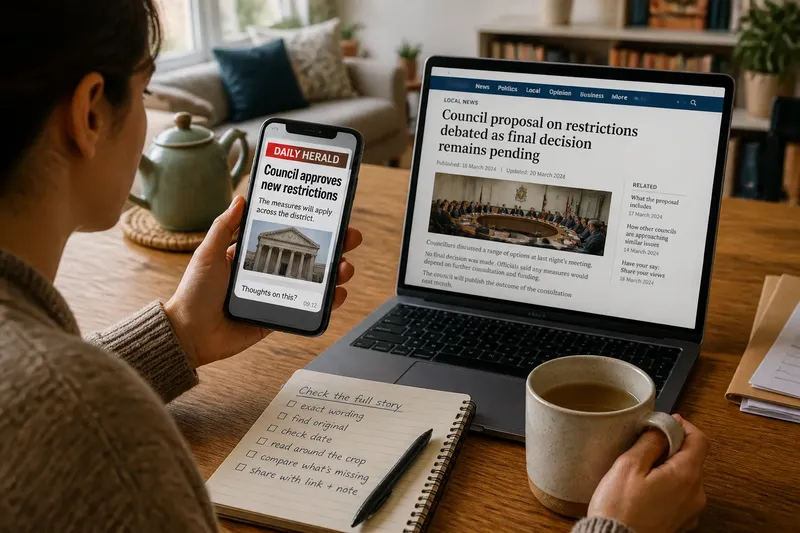
Headline, Standfirst or Caption: Where Does the Context Sit?
Headline, standfirst or caption: learn what each element can establish, what it leaves out and how to return to the report for the fuller account.

You open a news story on your phone while waiting for the kettle, and the headline seems to settle the matter. A photograph beneath it appears to confirm the claim; a short line of text adds a name or place. Yet these elements do different jobs. To read a headline, standfirst or caption well, treat each as an entry point, then return to the body of the report for the account that supports or qualifies it.
That distinction matters because a news page is edited in layers. The headline gives a quick route into the story, the standfirst supplies a little more orientation, and the caption identifies or describes an image. None should be mistaken for a complete substitute for the reporting beneath them.
What does a headline establish?
A headline tells you what the newsroom considers the story’s central point. It may report a decision, describe a change, identify a dispute or foreground a consequence. Its compact wording is useful: it lets readers scan a page and decide what to open.
But a headline is not usually the whole claim, still less the evidence for it. Short space can mean that conditions, attribution or uncertainty sit elsewhere. “Council approves new transport plan”, for example, tells you that a decision was made. It does not tell you which parts were approved, whether the plan is final, who voted for it or when changes are meant to begin.
Notice the verbs. “Says”, “plans”, “faces” and “approves” describe different things. A headline that reports what an organisation says is not necessarily asserting that the statement is independently established. If the wording feels stronger than the evidence you would expect, keep that question in mind as you read on.
Use the headline to identify the report’s subject and central proposition, not to decide every detail before you have seen the account.
What is a standfirst for?
A standfirst is the brief text placed under a headline, often set in larger or heavier type than the main copy. It commonly adds the detail that would make the headline unwieldy: who is affected, what prompted the development, or what the report will examine.
It can also narrow the headline’s meaning. A headline might say that a school is changing its admissions policy; the standfirst may specify that the change applies to future applicants, not pupils already enrolled. That extra clause can prevent a reader from carrying the wrong impression into the story.
Still, the standfirst is an edited summary, not a separate piece of evidence. It may leave out a caveat, a disagreement or the distinction between a proposed measure and one already in force. Read it as a helpful signpost: it tells you what to look for in the report, while the body should explain how the claim is supported and what limits apply.
If the headline and standfirst seem to pull in different directions, do not choose one by instinct. Open the report and check how its first paragraphs frame the development and what later details add.
What can a caption tell you about an image?
A caption names or describes what readers are seeing. It may identify a person, location, event or object; it can also give the date or circumstances in which an image was made. When a photograph is not self-explanatory, this information helps prevent readers from guessing.
A caption also sets boundaries. A picture of a crowded platform might show a particular station at a particular moment, but it cannot by itself establish that every station is crowded or that a new policy caused the scene. The caption can tell you where the image belongs in the report. The body must make the wider argument and explain its basis.
Look for the wording that connects picture and story. Does the caption say the image shows the event being reported, or merely a related place? Is it a file photograph, an illustration or a scene from an earlier occasion? Those distinctions affect what the picture can reasonably support.
For a graphic, map or chart, check its title, labels, units and stated source as well as the accompanying caption. A visual can clarify a report, but an unexplained scale or missing time frame can make its message hard to interpret.
Why can the three elements seem to tell different stories?
They have different space, purposes and points of emphasis. A headline must catch the central development in a few words; a standfirst can add a qualification; a caption must orient readers to a visual. Editors may also write these elements for readers who have not opened the full report. The result can feel uneven even when each element is doing its own job.
Imagine a report about a town’s proposed low-traffic zone. Its headline says the council is “bringing in” the zone, while the standfirst says councillors have approved a consultation on the proposal. A photograph shows a bus on the affected road, captioned as a morning scene. The body explains that the measure is not yet final and sets out the next decision. The first phrase sounds settled, but the standfirst and report qualify it; the photograph gives a sense of place, not proof that the change has happened.
In a case like that, the body is where you should look for the account’s sequence and qualifications. It may reveal a headline that is compressed, a standfirst that corrects an easy misreading, or a caption that simply identifies the image. If the mismatch remains unresolved after reading, the story has left an important question unanswered; do not silently supply the missing connection yourself.
How should you move from the page furniture to the report?
Read the headline and standfirst together, then pause over any strong verb or broad phrase. Ask what the wording actually claims: an event occurred, someone made an allegation, a decision is pending, or a change is expected? That small distinction gives you a useful question to carry into the article.
Next, inspect the caption if an image is central to the page. Identify what the caption says the image depicts and whether it places the scene in time and location. Keep the visual’s limits separate from the report’s claims.
Then read the opening of the body and continue until the report explains the central claim. A first paragraph may give the immediate development; the following paragraphs often provide the decision-making context, attribution or response. Do not stop at the first sentence if the headline makes a claim that depends on a condition or a disputed account.
As you read, look for the bridge between the summary and the reporting: who is making the claim, what event or document supports it, what is known directly, and what remains unsettled. The point is not to demand that every headline carry every caveat. It is to see whether the story itself supplies the context the short elements cannot hold.
What should you check when the wording feels stronger than the report?
Compare the headline’s verb with the body’s verb. A headline may use a concise phrase where the report says a proposal is under discussion, a source alleges a cause, or officials expect an outcome. Those are not interchangeable. Follow the body’s more precise account rather than carrying the stronger wording forward as fact.
Check the scope, too. Does a claim refer to one neighbourhood, a particular group, a single meeting or a wider population? A short summary may omit those limits. The report should make clear what its information covers; if it does not, treat the broadest reading with care.
Finally, look for what the article says it cannot establish. A report may distinguish confirmed details from estimates, explain that a cause is not yet known, or state that a person or organisation has not responded. Such qualifications are part of the account, not disposable fine print.
- Circle the main verb in the headline and identify whether it states an event, a claim or an expectation.
- Read the standfirst for conditions, dates, groups affected or a narrower description of the development.
- Check whether the caption identifies the image as current, archival, illustrative or from a different setting.
- Find the paragraph that explains the basis for the headline’s central claim.
- Compare the headline’s scope with the limits described in the body.
- Keep unresolved points unresolved rather than inferring an answer from the photograph or summary.
Where should you look when a page leaves a question open?
Is a headline a claim or just a label?
It can be either, depending on its wording. A headline may state a reported event, summarise a source’s assertion or simply name the subject, so check the verb and the article’s attribution before deciding which.
Does a standfirst contain the whole story?
No; it is a short orientation to the report and often adds one important qualification. Use it to decide what detail to check in the body, not as a replacement for that account.
Can a caption prove what happened?
A caption can identify what an image is said to show and add relevant context. The image and caption alone rarely establish the broader cause, scale or significance that a report may discuss.
What if the body never resolves the mismatch?
Keep the uncertainty visible and avoid repeating the strongest version as settled fact. You can compare the report with other coverage or seek clarification from the outlet if the distinction matters to your decision.
How do these elements work together?
Think of the headline as the doorway, the standfirst as a sign pointing towards the central detail, and the caption as a label for the visual. They can help you enter a report quickly, but they are not three independent confirmations of the same claim. Often they come from the same editorial account and serve different purposes.
That is why returning to the body matters. A headline can be concise without being complete; a standfirst can clarify without supplying the full reasoning; a caption can identify an image without explaining what it means for the wider story. The report should carry the account: its sequence, supporting material, attribution, limits and any meaningful response.
Next time a headline catches your eye, note what it actually says, let the standfirst and caption orient you, then find the paragraph that explains how the story knows. The context sits across the page, but the body is where the account has room to show its workings.