Before the Byline: How News Desks Took Shape
News desk history explains how editors coordinate reporting, shape stories for publication and adapt their roles to print, broadcast and digital work.
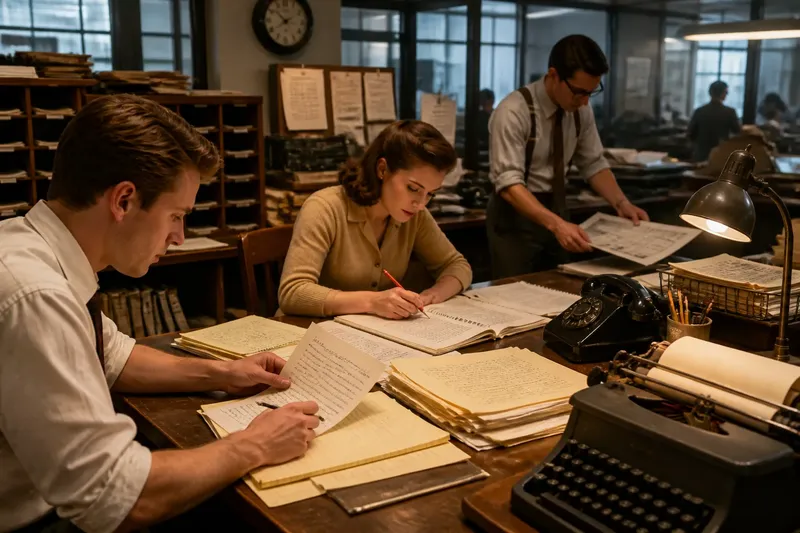
A reporter’s handwritten notes reach an editor as the evening paper is being prepared. One person checks a name, another trims a paragraph to fit the page, and a compositor waits for the final copy. News desk history begins with these practical handovers: people working out how to turn incoming material into a publishable report.
There was no single invention or universal path from that scene to today’s newsroom. The arrangements described here are broad patterns, not a fixed timeline followed by every publication. Print, broadcast and digital outlets have shaped editorial roles around their own deadlines, staff and production methods.
Print production made handovers part of editorial work
In early newspaper production, selecting material, editing it and preparing it for printing could be handled by people whose responsibilities overlapped. As a paper took in more reports, someone had to decide what belonged in an issue, where it should appear and what still needed attention before the pages were made.
That work was tied to the demands of printing. Editors had to pass copy along in a workable order, while late changes could affect the page being prepared. A “desk” came to mean more than a physical table: it could describe the coordination point where editorial decisions and production needs met.
The useful detail is not a neat origin date, but the change in the work itself: selecting, editing and producing a paper called for clearer handovers as operations grew.
Telegraph and wire copy increased the need to sort incoming reports
Telegraph networks and news agencies allowed reports to travel between places and subscribing publications. A local newsroom receiving wire copy had to decide how it fitted its own coverage, whether a newer version had arrived and what needed clarification before publication.
Editors might track dispatches, mark changes and send copy to the next person preparing a page. The exact roles varied, but the practical questions were familiar: Is this the current version? Does it repeat material already in hand? What can the report support as written?
Faster delivery did not settle those questions. The desk helped organise decisions about incoming material; it did not make the material self-explanatory.
Beat reporting connected recurring coverage with subject editors
Some newspapers assigned reporters to recurring subjects such as courts, local government, business or sport. Familiarity with a beat could help a reporter follow an issue over time, while an editor could route related material to someone who knew the topic.
Reporting and desk editing remained distinct kinds of work, even when one person did both. A reporter gathered and developed information; an editor could query an unclear passage, request a missing detail or decide how the report fitted the publication’s coverage. A small team might combine these jobs, while a larger one could divide them among reporters, section editors and a central desk.
Look at the work assigned to a role, not just its title: newsroom labels differ, and duties often overlap.
Sub-editors shaped copy as well as its appearance
In many newspaper workflows, sub-editors prepared copy for publication. They could refine wording, check names against the material available, write headlines and fit a report to the space on a page. Their decisions affected meaning as well as presentation.
A shorter version might lose a qualification. A headline might place emphasis on one part of a report. Moving a story could change its prominence. Editing therefore involved more than correcting grammar: it required keeping the published wording in line with what the reporting supported.
Page space and deadlines also shaped choices. Editors had to balance clarity, urgency and the room available, and different publications handled those pressures in different ways.
Broadcast desks coordinated scripts, sound and pictures
Radio and television brought different production needs. Radio scripts had to make sense when heard, while television combined spoken words with pictures, captions and edited footage. Editors and producers coordinated reports with bulletins, programmes, field crews and transmission schedules.
A broadcast team might decide whether a report belonged in a bulletin, whether to use a live reporter or a recorded package, and how to fit the item into the programme. Those choices shaped what audiences received. Pictures could supply context, but they could also draw attention away from a qualification in the script.
Broadcasting did not replace print’s coordination work. It gave newsrooms another set of formats and deadlines to organise.
Digital publishing extended editorial work beyond the edition
Online stories can be updated after publication, linked to earlier coverage and displayed across different platforms. Editors may need to keep the headline, summary and story text aligned as new material arrives, and decide how to make a change clear to readers.
Some organisations created digital desks; others included digital editors in existing teams or assigned the work to subject sections. Newsletters, alerts and social posts can carry shortened versions of a story, so a newsroom has to coordinate those forms with the reporting they draw on.
There is no single digital structure that suits every outlet. A small local team and a large national newsroom may assign these responsibilities differently because their staff and working arrangements differ.
News desk history reflects different ways to assign responsibility
Today, a newsroom may have subject editors, a central news desk, planning staff, live coverage teams, audience editors or reporters who publish with editing support. Titles vary, and similar responsibilities can sit with different people in different organisations.
Imagine a local newsroom covering a council meeting while preparing a morning newsletter. In this invented situation, the starting inputs are a reporter’s notes, a confirmed council decision and an unresolved question about when a new rule takes effect. The editor coordinating live updates publishes the confirmed decision and marks the timing as unresolved; the newsletter editor receives the same note and holds back a definite start date. The observable result is that both versions carry the confirmed information, neither states an unconfirmed date, and the newsroom can update both if the reporter later verifies it. If one editor must handle both tasks, the alternative is to record the unresolved point in a shared handover note before either version is published.
For readers, the desk’s name is less revealing than the work attached to it. A clear handover helps colleagues know what has changed, who is following up and which version needs attention.
How can a reader understand a newsroom’s structure?
Does every publication have a central news desk?
No. Some have a named central desk, while others distribute coordination among reporters, producers and section editors. The important distinction is whether responsibility for editing and handovers is clear.
Why do some newsrooms have subject editors?
A subject editor can coordinate continuing coverage and bring familiarity with a particular area. Outlets without that staffing arrangement may ask a general editor or reporter to cover several subjects.
How do reporting and editing differ?
Reporting usually involves gathering and developing material; editing involves shaping, reviewing and placing it for publication. In a small team, one person may do both, so the job title alone may not reveal the division.
Does a desk’s structure establish whether a story is reliable?
No. An organisational chart can show how work is assigned, but it cannot settle whether a particular report supports its claims. A reader should treat the structure as context, not as a verdict on an individual story.
News desk history is most useful as a way to understand the route a report may take before publication. When a correction or update appears, the practical question is whether the newsroom has made the change clear and passed it on to the places where that version is being used.